
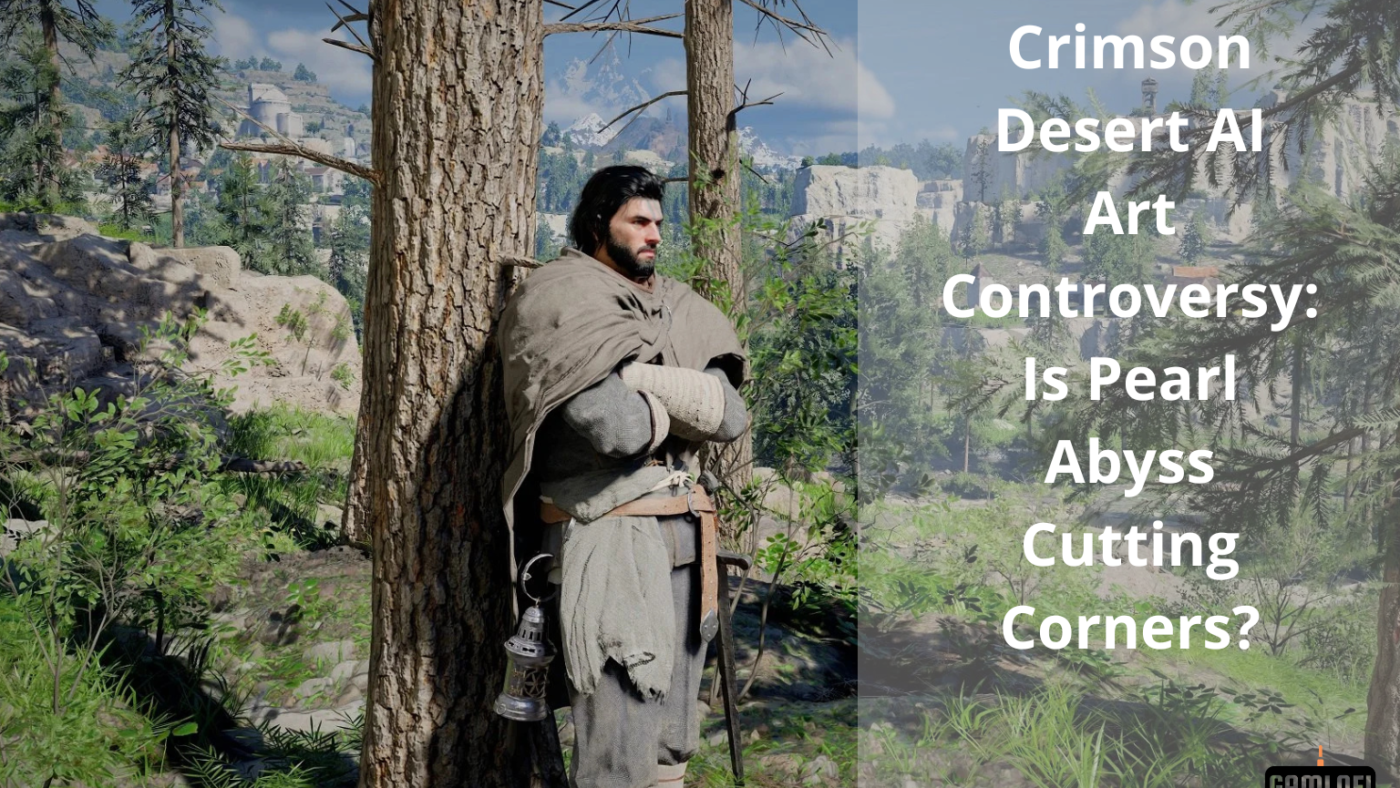
Crimson Desert Under Fire: The AI Art Controversy Shaking Pearl Abyss
Since its breathtaking reveal trailers, Crimson Desert has been hailed as the next evolution of open-world RPGs. Developed by the South Korean powerhouse Pearl Abyss, the game promised a level of graphical fidelity that seemed almost too good to be true. However, following its recent global launch, the community has discovered a “glitch in the matrix” that has nothing to do with frame rates, but everything to do with artistic integrity.
Social media platforms, led by the r/CrimsonDesert subreddit and X (formerly Twitter), are currently flooded with screenshots showcasing what appear to be AI-generated environmental assets. While the core gameplay remains stellar, the “devil in the details” is causing a massive PR headache for the studio.
The Evidence: The “Six-Legged Horse” Phenomenon
The controversy started in the bustling capital city of Hernand. Players exploring the local taverns and merchant stalls noticed something strange about the background paintings and decorative tapestries. High-resolution photo modes revealed “impossible” anatomical errors typical of early-stage AI image generation.
The most viral evidence includes:
- Anatomical Nightmares: Paintings of horses in the background featuring five or six legs and mangled hooves.
- Architecture Failures: Cityscape posters where windows melt into walls and stairs lead to nowhere, a classic sign of AI hallucination.
- Garbled Text: Signs that should feature the game’s lore-heavy script instead display “gibberish” characters that resemble distorted Latin or Cyrillic.
“When you pay $70 for a AAA experience, you expect every asset to be crafted by a human hand, especially from a studio known for its incredible art department,” says one prominent gaming influencer.
Read also: Fortnite V-Bucks Price Increase 2026: New Prices Explained
A Growing Trend in the AAA Industry?
This isn’t just about Crimson Desert. The gaming industry is at a crossroads. With development costs skyrocketing and maps becoming larger than ever, studios are increasingly turning to Procedural Content Generation (PCG) and Generative AI to fill the gaps.
Ubisoft and Square Enix have already hinted at using AI to help with NPC dialogue and background textures. However, the backlash against Pearl Abyss stems from the perceived “laziness” of leaving unedited AI artifacts in a premium product. It raises a vital question: At what point does efficiency turn into a loss of quality?
Pearl Abyss’s Official Stance
In an official press release sent to major outlets this morning, Pearl Abyss addressed the concerns. They stated:
“Our goal with Crimson Desert was to create a living, breathing world of unprecedented scale. To achieve this, we utilized internal procedural tools to assist our environmental artists. We acknowledge that some background assets did not receive the final manual polish required by our internal standards. We are committed to replacing these assets in an upcoming patch.”
While the studio didn’t explicitly use the term “Generative AI,” the admission of using “internal procedural tools” that require “manual polish” is, for many, a confirmation of the community’s suspicions.
What This Means for Players
For the average player, these distorted paintings don’t break the game. The combat is still fluid, and the story of Kliff and his mercenaries is as compelling as ever. However, for those who value world-building and immersion, these “AI scars” are a blemish on an otherwise masterpiece.
Impact on SEO and Trust: If you are a fan of the genre, it’s worth noting that the game is still receiving high scores for its mechanics, but its “User Score” on Metacritic is currently being hammered by “AI-protest” reviews.
Read also: Cyberpunk 2077 Xbox Game Pass: What Subscribers Get
Conclusion: The Future of Art in Gaming
The Crimson Desert controversy serves as a warning shot to the rest of the industry. AI can be a tool, but it cannot be a replacement for the human eye. As developers move forward into 2026 and beyond, the balance between technology and craftsmanship will be the ultimate test of a studio’s legacy.
Join the Discussion: Does the use of AI in background assets bother you, or is it a necessary evil for massive open-world games? Let us know in the comments!